CHANGING THE LEGAL REPRESENTATIVE OF A FOREIGN-INVESTED ENTERPRISE IN VIETNAM: KEY LEGAL REQUIREMENTS AND PRACTICAL CONSIDERATIONS

During the course of business operations in Vietnam, a foreign-invested enterprise (FIE) may need to change its legal representative as a result of corporate restructuring, management changes, the expiry of an appointment, or a decision made by its owner, members, or shareholders.
At first glance, changing a legal representative may appear to be a routine enterprise registration procedure. However, a legal representative is the individual legally authorised to act on behalf of an enterprise in exercising its rights and performing its obligations. Accordingly, a change of legal representative may affect not only the information recorded on the Enterprise Registration Certificate (ERC), but also the enterprise’s signing authority, corporate governance arrangements, and ongoing legal relationships.
For foreign-invested enterprises, the process should also be considered in the context of the company’s ownership and management structure, existing investment documentation, and any legal requirements applicable to the newly appointed representative, particularly where that individual is a foreign national.
The essential issue is therefore not merely how to register a new legal representative, but how to establish the proper decision-making authority, comply with the applicable registration procedures, and manage the transition without unnecessarily disrupting the enterprise’s legal and business operations.
1. The Role and Legal Status of a Company’s Legal Representative
Under Article 12 of Law on Enterprises No. 59/2020/QH14, as amended and supplemented, a legal representative is an individual who represents an enterprise in exercising rights and performing obligations arising from its transactions, represents the enterprise in legal proceedings, and performs other rights and obligations prescribed by law.
Vietnamese law permits limited liability companies and joint-stock companies to have one or more legal representatives.
The company’s charter must specify the number of legal representatives, their management titles, and their respective rights and obligations. Where the company has more than one legal representative, the allocation of authority and responsibilities among them should be clearly set out in the charter.
Importantly, where the allocation of rights and obligations is not clearly specified, each legal representative is deemed to have full authority to represent the enterprise before third parties. Their joint liability for damage caused to the enterprise is determined in accordance with the applicable statutory provisions.
This means that the appointment of legal representatives, and the allocation of authority between them, involves more than a personnel decision. It is also an important aspect of corporate governance and legal risk management.

A further distinction must be made between the legal representative of the enterprise and an authorised representative of a corporate owner, member, or shareholder.
An authorised representative acts on behalf of the organisation that appointed them, within the scope permitted by law and the relevant authorisation. Being appointed to represent an investor’s ownership interest does not, by itself, make that individual the legal representative of the enterprise.
For foreign-invested companies, this distinction is particularly relevant where the foreign owner or investor is itself a corporate entity acting through designated representatives in Vietnam.
2. Identifying the Corporate Authority to Approve the Change
Before initiating the registration procedure, an enterprise should determine which person or corporate body has the legal authority to approve the appointment or replacement of its legal representative.
The applicable authority depends on the enterprise’s legal form, governance structure, and current charter.
Under Article 43 of Decree No. 168/2025/ND-CP, the supporting corporate resolution or decision required for registration varies according to the type of enterprise.
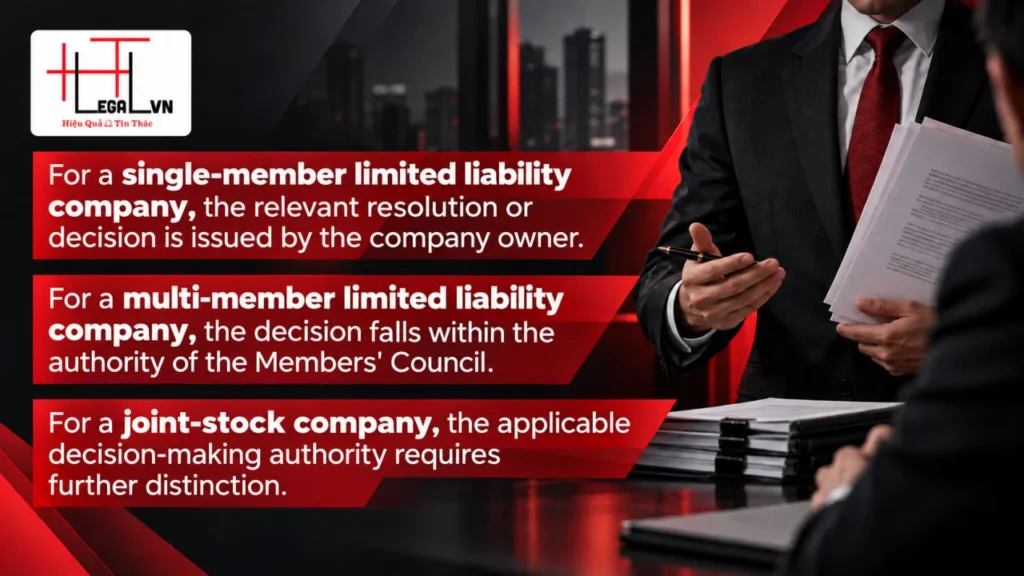
Where the change of legal representative entails an amendment to the company’s charter beyond changes to the representative’s personal information and signature as contemplated under Article 24 of the Law on Enterprises, the relevant resolution or decision must be adopted by the General Meeting of Shareholders.
Where the change does not result in such an amendment to the charter, the decision falls within the authority of the Board of Directors, in accordance with the applicable provisions.
It would therefore be incorrect to assume that every change of legal representative in a joint-stock company can be approved solely by the Board of Directors.
Where the owner or a member of a foreign-invested enterprise is a foreign corporate entity, the company should also examine whether the person signing the relevant resolution or decision has been duly authorised to act on behalf of that entity.
The form, execution, and legal acceptability of the supporting documents for use in Vietnam may also require consideration.
A registration dossier may appear complete in form yet still raise legal concerns if the underlying corporate decision was not adopted by the proper authority.
3. Matters to Review Before Appointing the New Legal Representative
Before submitting an application to register a new legal representative, the enterprise should establish whether the proposed appointee satisfies the legal requirements applicable to the intended position.
The review may include the individual’s legal capacity and identification particulars, management title, proposed scope of authority, and any relevant conditions imposed by the Law on Enterprises, the company charter, or applicable sector-specific legislation.
Where an enterprise has multiple legal representatives, it is important to clarify whether the proposed change involves replacing an existing representative, appointing an additional representative, or revising the allocation of authority and responsibilities among them.
The Requirement to Maintain a Legal Representative Resident in Vietnam
Article 12.3 of the Law on Enterprises requires an enterprise to ensure that at least one of its legal representatives resides in Vietnam.
Where the enterprise has only one legal representative residing in Vietnam, that individual must comply with the statutory authorisation requirements when leaving the country.
This requirement is particularly relevant to foreign-invested enterprises whose legal representatives are foreign nationals or regularly travel between Vietnam and other jurisdictions.
A company’s management arrangements should therefore be assessed not only by reference to the proposed appointment, but also by reference to the continuing ability of the enterprise to satisfy its statutory representation requirements.
Additional Considerations for Foreign Nationals
Where the newly appointed legal representative is a foreign national who will personally work in Vietnam, the enterprise should separately consider the applicable rules on foreign employment and immigration status.
Registration as a company’s legal representative does not automatically establish that the individual is entitled to work in Vietnam without a work permit or that all applicable immigration requirements have been satisfied.
Whether a work permit is required, or an exemption applies, must be determined by reference to the individual’s circumstances, the nature of their work, and the relevant legal provisions.
These matters should be considered separately from the enterprise registration procedure.
4. Registration Documents, Procedures, and Statutory Deadlines
Under Article 30 of the Law on Enterprises, an enterprise is generally required to register changes to the particulars recorded on its Enterprise Registration Certificate within 10 days from the date on which the change occurs.
For limited liability companies and joint-stock companies, Article 43 of Decree No. 168/2025/ND-CP governs the procedure for registering a change of legal representative.
The registration dossier includes an application for registration of the change of legal representative, together with an original or copy of the relevant corporate resolution or decision issued by the competent authority, as applicable to the company’s legal form.
The application must be submitted to the competent provincial-level Business Registration Authority in the locality where the company’s head office is situated.
The prescribed application is Form No. 13 in Appendix I to Circular No. 68/2025/TT-BTC. The enterprise should also confirm the documentary requirements, signatory authority, and submission procedures applicable at the time of filing.
An important procedural issue is that the person authorised to sign the application to register a change of legal representative is not necessarily the outgoing or incoming legal representative.
Under Article 43.2 of Decree No. 168/2025/ND-CP, the application is ordinarily signed by:
For a limited liability company, the Chairperson of the Members’ Council or the Company President, as applicable.
For a joint-stock company, the Chairperson of the Board of Directors.
Where the incumbent chairperson is also the legal representative being replaced, the Decree provides for the relevant application to be signed by the newly appointed or elected chairperson, as applicable.
The Decree also addresses certain circumstances involving the absence or inability of the relevant chairperson to perform their duties, as well as other specified legal situations.
Accordingly, where an outgoing legal representative has resigned, ceased cooperating with the company, or is otherwise unable to sign documents, it should not automatically be assumed that the registration procedure cannot proceed.
Instead, the enterprise should first determine the appropriate signatory in accordance with its legal form and the applicable statutory provisions.
Processing Time
Under Article 43 of Decree No. 168/2025/ND-CP, the provincial-level Business Registration Authority must examine the validity of the application within three working days from receipt of the registration dossier and issue an updated ERC where the statutory requirements are satisfied.
Where the dossier is invalid or incomplete, the authority must notify the enterprise in writing of the matters requiring amendment or supplementation.
The statutory processing period should not be interpreted as an unconditional guarantee that every application will be approved and processed within three working days, irrespective of the completeness or validity of the submitted documents.
Electronic Registration and Authorised Filing
Decree No. 296/2026/ND-CP, effective from 23 July 2026, amended and supplemented certain provisions governing enterprise registration, including electronic authentication requirements applicable to authorisation arrangements for specified registration procedures.
These requirements are relevant to applications involving changes of legal representatives.
Where an application is submitted through an authorised person, the enterprise should verify the applicable electronic authentication requirements, authorisation documents, and supporting personal identification documents.
A company should therefore review the requirements in force at the time of filing rather than assume that documents or filing practices used for previous registrations remain sufficient.
5. Does a Change of Legal Representative Require an Amendment to the Investment Registration Certificate?
This is an important issue for foreign-invested enterprises.
The Enterprise Registration Certificate (ERC) and the Investment Registration Certificate (IRC) serve distinct legal purposes.
A change of legal representative is an enterprise registration matter. However, this does not mean that every such change automatically requires an amendment to the company’s IRC.
Under Article 33.2 of Law on Investment No. 143/2025/QH15, an investor must carry out procedures to amend an IRC where an adjustment to the investment project changes the principal particulars of that project as recorded in the certificate.
Accordingly, when changing its legal representative, a foreign-invested enterprise should examine its existing investment records to determine whether the proposed change also affects any project-related particulars that are subject to adjustment requirements under investment law.
Where the change concerns only the individual appointed as legal representative and does not alter any investment project particulars requiring amendment, the completion of the ERC registration procedure should not, by itself, be treated as giving rise to an additional obligation to amend the IRC.
Conversely, where the enterprise is simultaneously making other changes affecting its investors, investment project, or information recorded in its investment documentation, any associated investment procedures must be assessed separately.
This distinction helps enterprises avoid both unnecessary administrative procedures and the risk of overlooking obligations that genuinely arise from changes to an investment project.
6. Legal and Operational Matters Following the Change
Issuance of an updated ERC is an important milestone, but it does not necessarily mark the completion of every legal and administrative task associated with the change of legal representative.
Depending on the company’s circumstances, further action may be required in relation to its internal records, banking arrangements, electronic systems, and existing contractual relationships.
Corporate Records and Management Handover
The enterprise should review the handover of corporate records, contracts, internal documents, system access rights, and ongoing matters previously handled by the outgoing representative.
The scope and timing of the handover, together with responsibility for outstanding tasks and obligations, should be clearly established.
A properly documented transition can help prevent uncertainty concerning management authority and responsibility during the period of change.
Banking and Authorised Signatories
The enterprise may need to update information maintained by its banks, including particulars of the legal representative, persons authorised to operate bank accounts, account signatories, and customer identification records.
The required steps should be determined in accordance with applicable banking requirements and the company’s existing account arrangements.
Digital Signatures and Electronic Platforms
Where the enterprise uses digital signatures, electronic tax systems, or other online transactional platforms, the relevant registration details, system administrators, and persons authorised to conduct transactions should be reviewed.
A change of legal representative does not necessarily result in an automatic change to every electronic access right or signing authority associated with the enterprise.
Accordingly, the company should identify which authorisations and system records require updating.
Contracts and Existing Obligations
Whether counterparties need to be notified or contractual particulars updated will depend on the relevant agreements, representation arrangements, and practical circumstances.
Importantly, a change of legal representative does not, in itself, terminate the enterprise’s existing contracts, debts, or other legally established obligations.
Those obligations remain subject to the applicable legal framework and contractual terms.
Likewise, any personal liability that may have arisen on the part of the former legal representative is not automatically extinguished merely because that individual no longer holds the position.
A clear and properly documented transition can therefore help reduce operational disruption and potential disputes concerning responsibility before, during, and after the change.
7. Illustrative Legal Scenario
Consider a hypothetical single-member limited liability company operating in Vietnam with 100% foreign ownership.
The company owner decides to appoint a new legal representative because the incumbent representative will no longer continue in that role.
The company does not intend to change its charter capital, ownership, registered head office, investment objectives, or project scale.
In these circumstances, the enterprise should first examine the authority of the person issuing the owner’s decision, the legal eligibility of the proposed representative, the provisions of the company charter, and the person authorised to sign the registration application.
The enterprise must then determine and comply with the applicable requirements for registering the change to its ERC.
In relation to the investment documentation, the existing project records should be examined to establish whether any particulars requiring adjustment have changed. An application to amend the IRC should not be prepared automatically solely because the company has appointed a new legal representative.
Following completion of the enterprise registration procedure, the company should review the handover of management responsibilities, updates to its banking records, and other matters relevant to its continuing operations.
This scenario illustrates how an apparently straightforward management change may nevertheless require several distinct legal and administrative considerations.
It also demonstrates that the presence of foreign ownership does not mean that every internal corporate change necessarily requires multiple investment-related procedures.
This scenario is provided solely for illustration and does not describe an actual client matter.
8. Documents to Review Before Initiating the Change
Before preparing the formal registration dossier, the enterprise should review its current ERC, company charter, and the identification and appointment details of both the outgoing legal representative and the proposed replacement.
The company should also examine its corporate governance structure, the authority of the person or body responsible for approving the change, the authority of the person signing the registration application, and any relevant internal resolutions or decisions.
Where the enterprise is owned or invested in by a foreign corporate entity, documents establishing that investor’s legal status and the authority of persons acting on its behalf may require consideration.
Where the enterprise is implementing an investment project, its IRC and other project-related legal documents may also need to be reviewed to assess the effect, if any, of the proposed change on existing investment records.
These documents are relevant to the preliminary legal assessment. They should not be treated as an exhaustive list of documents that must be submitted to the Business Registration Authority in every case.
The formal registration dossier must be determined in accordance with the applicable regulations and the circumstances of the particular enterprise.
9. Ensuring Proper Registration and Continuity of Corporate Governance
Changing a legal representative involves both statutory registration requirements and internal corporate governance considerations.
For a foreign-invested enterprise, the relevant assessment should also take account of the foreign owner or investor, the company’s charter, existing investment documentation, and any legal requirements applicable to the proposed representative.
An appropriate legal approach should not be limited to obtaining an updated registration certificate.
It should also establish that the underlying decision was made by the competent authority, the application was properly executed and submitted, existing legal relationships were identified, and the transition of management responsibilities was appropriately addressed.
The value of legal advisory services lies not only in completing a registration procedure, but also in identifying the obligations that genuinely apply, avoiding unnecessary steps, and managing foreseeable legal risks arising from the change.
This is a practical aspect of sound corporate governance for foreign-invested enterprises operating in Vietnam.
RELATED LEGAL SERVICES – HT LEGAL VN
Legal Advisory and Registration Assistance for Changes of Legal Representatives
HT Legal VN provides legal advisory services to foreign-invested enterprises operating in Vietnam, with a focus on enterprise registration matters and routine corporate changes arising in the course of business operations.
In relation to changes of legal representatives, HT Legal VN advises on the competent decision-making authority, reviews the relevant corporate documents, identifies the applicable registration procedures, and assists with preparing and submitting the required documents within the agreed scope of engagement.
Depending on the circumstances, the engagement may also involve reviewing relevant provisions of the company charter, existing investment documents, and legal matters requiring attention during the transition.
The scope of services, expected timeframe, and professional fees are determined with reference to the client’s particular circumstances and agreed upon before work commences.
HT Legal VN seeks to provide clear, proportionate, and legally grounded advice to help enterprises manage corporate changes and associated legal obligations.
HT LEGAL VN – Giải pháp đúng – Hiệu quả – Tín thác.
LEGAL REFERENCES
- Law on Enterprises No. 59/2020/QH14, as amended and supplemented, including by Law No. 76/2025/QH15, particularly Articles 12, 13, 14, 24, and 30.
- Decree No. 168/2025/ND-CP, dated 30 June 2025, on enterprise registration, particularly Article 43.
- Decree No. 296/2026/ND-CP, dated 23 July 2026, amending and supplementing certain provisions of Decree No. 168/2025/ND-CP.
- Circular No. 68/2025/TT-BTC, dated 1 July 2025, prescribing forms used for enterprise and household business registration, particularly Form No. 13 in Appendix I; as supplemented and amended in relevant respects by Circular No. 121/2026/TT-BTC.
- Law on Investment No. 143/2025/QH15, effective from 1 March 2026, particularly Article 33.
Disclaimer: This content is prepared based on the laws and regulations in force at the time of publication and is provided for general informational and legal knowledge-sharing purposes only. It does not constitute legal advice for any specific matter and does not create any commitment or guarantee as to the outcome of any legal process. The application of law must be assessed based on the relevant documents, evidence, factual circumstances, and the laws and regulations in force at the applicable time.
HT LEGAL VN – RIGHT SOLUTIONS • EFFECTIVENESS • TRUST
HT Legal VN provides legal advisory services, litigation representation, and legal support for individuals and businesses across a broad range of practice areas.
Website: www.htlegalvn.com
Hotline: 09 6161 4040
HT LEGAL VN
Right Role – Right Authority – Act in Accordance with the Law.